01
Technical Expertise
Experienced security practitioners who go beyond automated tooling, validate what matters, and understand how vulnerabilities can be combined to create real attack paths.

About us
We are a UK-based cybersecurity consultancy helping organisations worldwide understand their security exposure, test their defences, and make informed decisions about risk.
Mission Statement
We help organisations understand where they are exposed, what those weaknesses mean in practice, and what they can do to reduce their risk.
Through penetration testing, security audits and bespoke security assessments, we challenge assumptions, investigate real-world attack paths and provide clear, independent evidence that organisations can act on.
We believe good security should leave an organisation better than we found it. Our purpose is to help protect the people, data and services that organisations are responsible for.
Principles
Effective security testing depends on more than technical capability. It requires experienced judgement, an understanding of your objectives, and confidence in the quality of the work delivered.
01
Experienced security practitioners who go beyond automated tooling, validate what matters, and understand how vulnerabilities can be combined to create real attack paths.
02
Testing shaped around your objectives, environment and risk. We focus on what a vulnerability means to your organisation, not simply what a scanner reports.
03
Quality is built into every stage of our work. Findings are rigorously validated, supported by evidence, and communicated with precision, giving security and technical teams confidence that the results accurately represent their environment.
04
Clear communication, disciplined testing and objective advice throughout. We report what we find without selling the remediation work that follows.
How an engagement runs
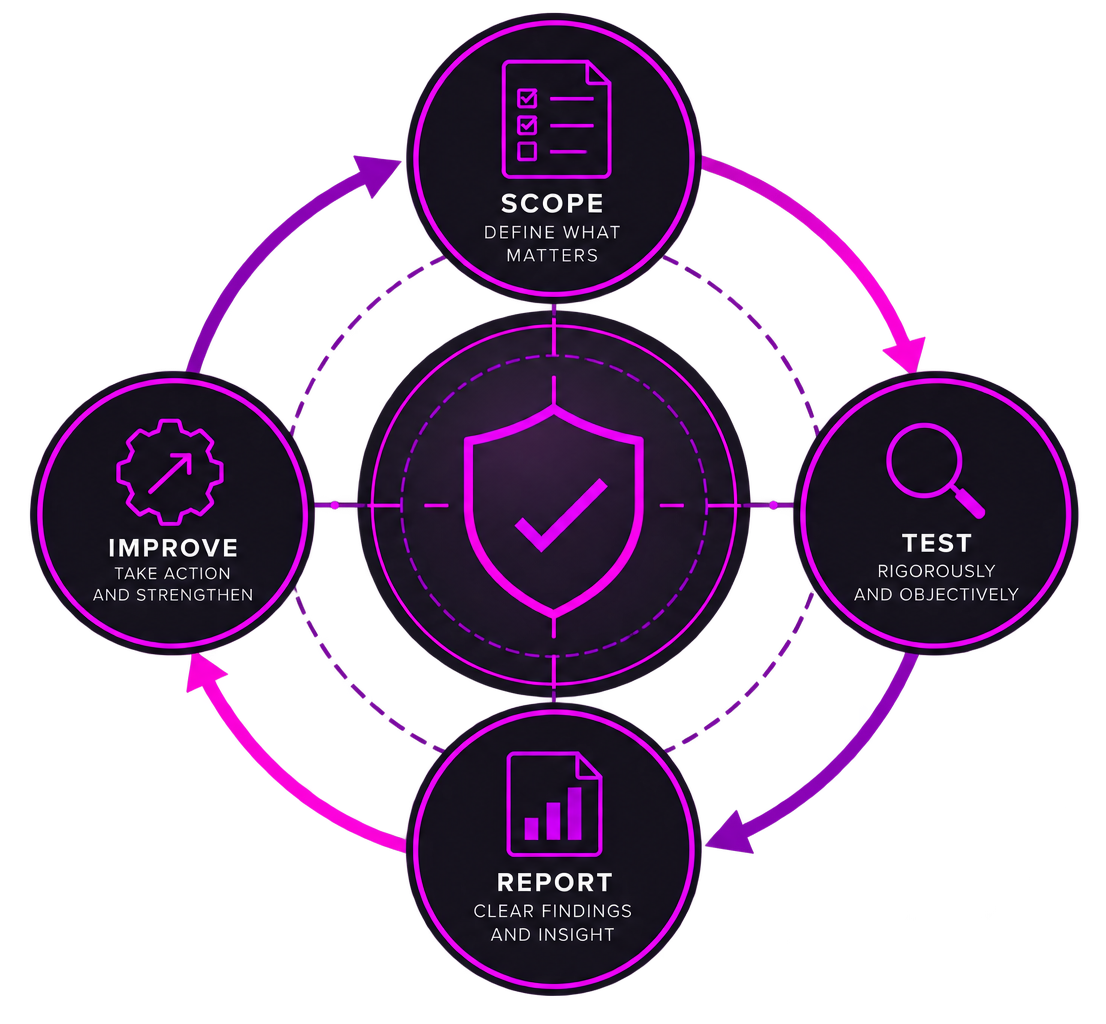
Every engagement is shaped around your objectives, environment and risk. While the scope and depth of testing will vary, our approach remains consistent: establish what matters, test it rigorously, communicate clearly, and provide findings your teams can act on.
We establish what you need to understand, what is in scope, and where the testing boundaries sit. This may be a conventional penetration test, an objective-led assessment, or a combination of both. Clear scoping ensures the assessment is relevant, proportionate and focused on the risks that matter.
Our experienced testers assess the agreed environment using a combination of established methodologies, manual techniques and targeted investigation. We look beyond individual vulnerabilities to understand how weaknesses may combine and what they could mean in a realistic attack.
Findings are validated, evidenced and assessed in the context of your organisation. Our reports provide the technical detail needed by engineering teams alongside the risk context required by security and leadership, with clear prioritisation and practical remediation considerations.
Once you have had time to review the report, we provide a debrief to discuss the findings, answer questions and ensure the risks are understood. Where appropriate, a focused or full retest can then validate that remediation has addressed the identified vulnerabilities.
Accreditations & recognition
When you trust an external security partner with access to your systems, the quality of their work matters. Our accreditations, certifications and industry recognition provide additional assurance around our technical capability, security and the way we deliver services.
43%
Of UK businesses experienced a breach or attack
612k
UK businesses affected
13%
Carried out penetration testing
29
NCSC-managed incidents linked to three CVEs
Sources: UK Government Cyber Security Breaches Survey 2025/2026; NCSC Annual Review 2025.
Questions we are asked
Absolutely. A penetration test does not have to follow a predetermined checklist. If you need to understand whether sensitive data can be accessed, whether a particular control can be bypassed, or how an attacker could move through a specific part of your environment, we can build the engagement around that question. The objective comes first; the testing follows.
No. Tools are useful for finding things; experienced testers are needed to understand what those things actually mean. We validate findings, investigate beyond the obvious, and look for ways individual weaknesses can combine into a meaningful attack path. If a scanner says something is vulnerable, that is the beginning of the investigation, not the end of it.
You will not have to wait for the report to find out. We raise materially concerning findings as soon as they are understood, using the communication channel that works for your team. Regular updates keep everyone aligned throughout the engagement, so there should be no surprises when the final report arrives.
Reporting tailored to the people who need to use it. Alongside detailed technical findings, we provide executive summaries for leadership and non-technical stakeholders, and can produce bespoke issue registers and spreadsheets where your teams or customers need information in a specific format. Every output is grounded in the same accurate evidence, giving everyone from technical teams to the C-Suite the clarity they need to understand risk and take action.
We adapt where it makes sense. Testing rarely happens in a perfectly static environment, so we keep communication open and make scope changes explicit rather than quietly making assumptions. Anything outside the agreed boundaries is treated as such, giving you flexibility without losing control of the engagement.
Yes, without becoming the team that fixes its own findings. We are always available to clarify issues, discuss the evidence and help your teams understand what needs to change. When remediation is complete, we can return to independently verify that the vulnerabilities have actually been addressed.
We will tell you honestly whether we are the right people for the work.